

Your Cart is Empty
On the leather
The Art of Vegetable Tanning
Where craft, tradition, and time turn raw hides into heirlooms. If you close your eyes inside a Tuscan tannery, the air itself begins to speak. It carries the warmth of bark and earth, the faint metallic tang of tools, the quiet hiss of water across stone floors. Sunlight falls through high windows, striking dust that drifts above great wooden drums, each turning at its own patient rhythm.
This is no place for haste. Here, time is measured not in hours but in seasons. Vegetable tanning in this corner of Italy is not merely a method; it is a heritage, passed hand to hand, master to apprentice, as carefully as a recipe that holds a family together.
For those who want leather worth carrying a lifetime, it begins here: in patience, in ritual, in a craft that refuses to be rushed.
What vegetable tanning is, and how it differs from chrome tanning
Vegetable tanning is one of the world's oldest arts: raw hides slowly steeped in the tannins of bark, roots, and leaves until they become supple, enduring leather. It is a process of weeks, sometimes months, the fibres drinking deeply from nature until they carry its strength within them. The result is leather that breathes, biodegrades, and lives with a character as unrepeatable as the tree it came from.
Chrome tanning, by contrast, is a child of industry. More than 90% of the world's leather is treated this way: hides immersed in chemical baths that can finish the job in days. Swift, yes, but at a cost. Natural textures are stripped away and replaced with synthetic finishes that shine briefly before cracking, peeling, or stiffening.
Vegetable-tanned leather takes the slower route. It grows more supple with every season, gathering patina and depth as it goes.
A heritage written in Tuscan soil
The roots of vegetable tanning in Italy run deep. The Etruscans, long before Rome, tanned hides with bark and leaves. Over centuries, Tuscan towns became homes of this craft, their tanneries built along rivers that carried both water and trade.
Some of those tanneries endure still, family-run, their knowledge passed down for generations. The tools have changed, but the care has not: every hide respected, every step measured, every piece meant to last longer than the hands that made it.
Step into one and you are stepping into a living lineage, loyal not to nostalgia but to a way of making that has proven itself over centuries.

The step-by-step process
1. Selection of hides. Every piece begins with a hide, not raised for fashion, but a by-product of the food industry. The best are chosen: strong in fibre, free of deep scars, carrying just enough marks to remember where they came from.
2. Soaking and preparation. The hides are bathed in water, the salts washed away, the fibres revived. This is the breath before the craft.
3. Tanning in drums. Wooden drums turn at an unhurried rhythm, filled with water and natural tannins. Slowly, the hides take in the essence of bark and leaf until strength and suppleness reach deep into the grain.
4. Drying and resting. After tanning, the hides rest in airy halls. No rushing heat, no harsh machines, just time and space. Here they gather resilience and flexibility.
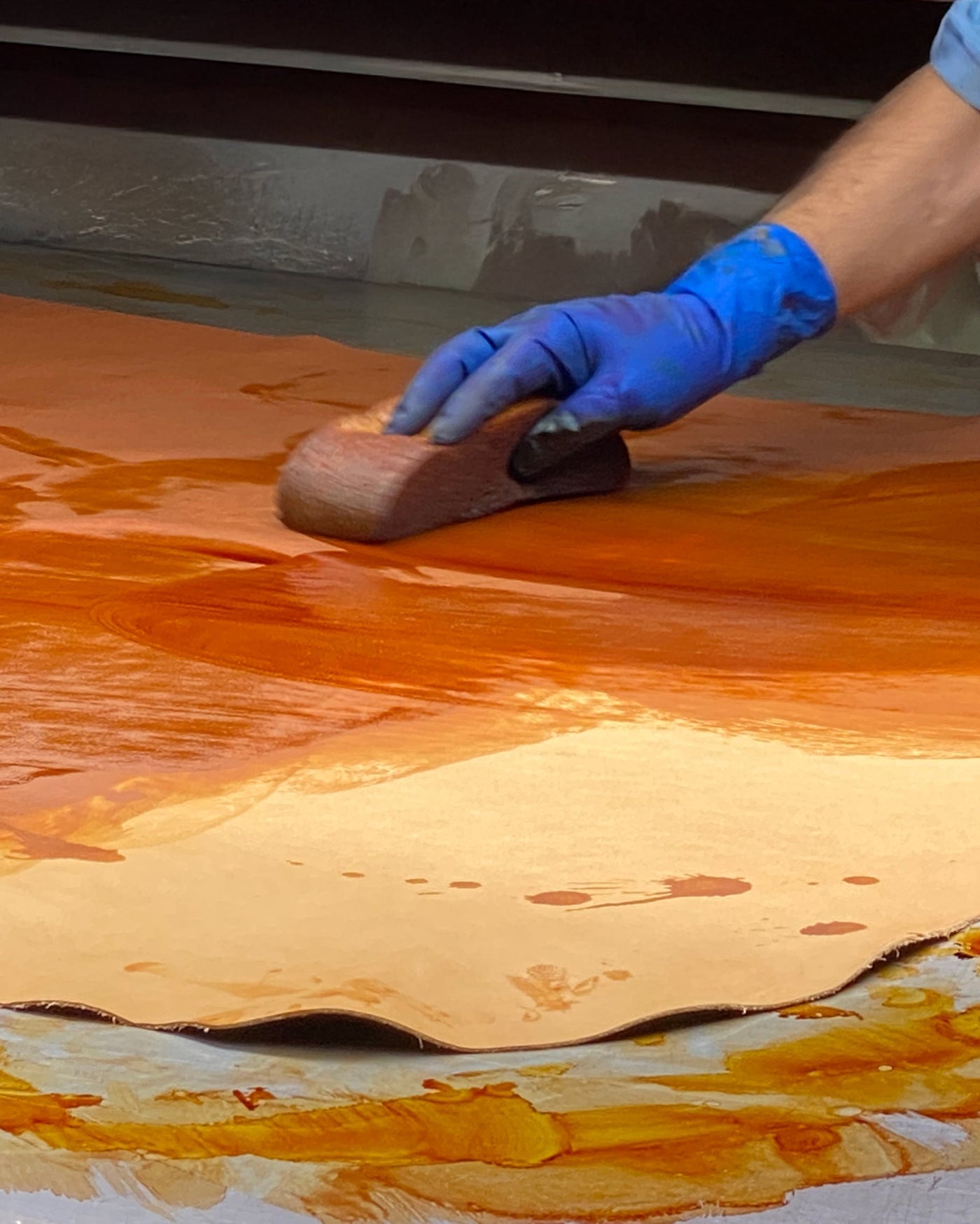
5. Hand-dyeing, the signature touch. Unlike leather dyed in vats, these hides are coloured by hand. Layer after layer, artisans press pigment into the grain with cloths or sponges, blending tone with tone. The colour does not cover the leather; it works with it. No two hides are ever the same, and those small variations in shade are not flaws but signatures.
6. Conditioning and finishing. Oils and natural waxes are worked in, giving either a soft glow or a matte finish, depending on the piece. Only then is the leather ready to be cut, shaped, and carried into your life.

The truest mark of authenticity is in the patterns left by hand-dyeing. No two are ever the same.
Why it's the more sustainable choice
Vegetable tanning is slower and more deliberate, and its touch on the planet is gentler.
- No harsh chemicals. Plant tannins replace chromium salts, sparing both waterways and workers.
- Biodegradable. At the end of its life, vegetable-tanned leather returns to the earth.
- Waste-conscious. The hides come from the food industry, so no animal is raised solely for its skin.
- Built to last. A bag that endures for decades is the clearest answer to disposable culture.
A Republic of Florence promise
We choose tanneries that treat vegetable tanning not as a process but as a principle. Every hide is respected rather than stripped of its story; its marks stay as quiet reminders that nature was here first.
Every bag we make carries this forward: craft, patience, and permanence. Not nostalgia, but a living tradition built to last beyond its maker.
When you carry our leather, you carry more than a bag. You carry time itself, shaped by hands that refuse to hurry.
